
| Publisher | Severn House |
|---|---|
| Date Published | 27 November 2015 |
| ISBN-10 | 0727885650 |
| ISBN-13 | 978-0727885654 |
| Format | paperback |
| Pages | 224 |
| Price | £ 19.99 |
Backhand Smash
by
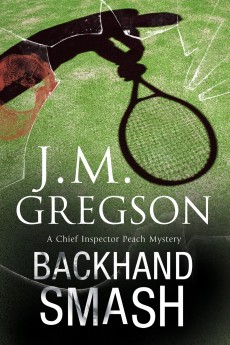
DCI Percy Peach and his sidekick DS Northcott investigate a murder at a snooty tennis club.
Review
Sometimes you read a book, ostensibly set in the present, which appears to be stuck in a time warp. Backhand Smash is one of those. And the best word I can think of to describe it is quaint. It’s not a twee cosy, but a rather oddly-pitched police procedural, which seems to be set in present-day Lancashire, featuring DCI ‘Percy’ Peach and his bagman, DS Clyde Northcott.
There’s a faintly strange frivolous feel to the writing, particularly when Peach spars with his ghastly superior Tucker. And the whole book comes across as jammed in that time warp, particularly when it comes to class and race. JM Gregson never saw a racial stereotype he couldn’t make use of. And as for the dialogue, Peach’s mother-in-law repeats ad nauseam: “Oh, go on with you, Percy Peach! You’re a regular caution, you are!” I was fully expecting a Kray-type gangster to appear and growl: “You’re on my manor!”
Instead, we get a shifty Asian chap of dodgy morals, and a load of toffs – or aspiring toffs – at a snooty tennis club. Which is where DS Northcott, who’s a big black lad (and yes, he has an unfortunate past dabbling in drugs before going straight), comes into it.
Northcott is a reasonable tennis player and the redoubtable Olive Crawshaw believes he’d be the ideal person to drag the tennis club into the 21st century. Naturally she faces opposition from other committee members who aren’t enamoured with Someone Who Is Not Like Us joining up.
You can of course guarantee that someone from the ever so exclusive club won’t survive to see the end of the book. So Northcott gets to show his investigative skills alongside his ground strokes, aided by the very perky PC Elaine Brockman.
In the end, Northcott turns out to be about the most interesting character. Peach, a strange little baldy guy, never rings quite true. But then that’s a problem with most of the cast, who are painted in broad brushstrokes.
Backhand Smash appears to be part of a long-running series. It nips along at a brisk pace, but I suspect that Gregson’s writing style will be an acquired taste for a lot of readers. If you can overlook the stereotyping and want an undemanding read, then the book may be worth a punt.
There’s a faintly strange frivolous feel to the writing, particularly when Peach spars with his ghastly superior Tucker. And the whole book comes across as jammed in that time warp, particularly when it comes to class and race. JM Gregson never saw a racial stereotype he couldn’t make use of. And as for the dialogue, Peach’s mother-in-law repeats ad nauseam: “Oh, go on with you, Percy Peach! You’re a regular caution, you are!” I was fully expecting a Kray-type gangster to appear and growl: “You’re on my manor!”
Instead, we get a shifty Asian chap of dodgy morals, and a load of toffs – or aspiring toffs – at a snooty tennis club. Which is where DS Northcott, who’s a big black lad (and yes, he has an unfortunate past dabbling in drugs before going straight), comes into it.
Northcott is a reasonable tennis player and the redoubtable Olive Crawshaw believes he’d be the ideal person to drag the tennis club into the 21st century. Naturally she faces opposition from other committee members who aren’t enamoured with Someone Who Is Not Like Us joining up.
You can of course guarantee that someone from the ever so exclusive club won’t survive to see the end of the book. So Northcott gets to show his investigative skills alongside his ground strokes, aided by the very perky PC Elaine Brockman.
In the end, Northcott turns out to be about the most interesting character. Peach, a strange little baldy guy, never rings quite true. But then that’s a problem with most of the cast, who are painted in broad brushstrokes.
Backhand Smash appears to be part of a long-running series. It nips along at a brisk pace, but I suspect that Gregson’s writing style will be an acquired taste for a lot of readers. If you can overlook the stereotyping and want an undemanding read, then the book may be worth a punt.
Reviewed 13 February 2016 by Sharon Wheeler


